In This Section
Vaping While Pregnant? Duke Study Reveals Dangers to Fetal Growth and Development in Mouse Model
Advanced Minimally Invasive Surgery for Complex Gynecologic and Oncologic Conditions

Some may believe flavored e-cigarettes are a safer alternative to traditional smoking, including during pregnancy. However, new research from Duke Health shows that vaping may pose serious risks to a developing fetus, even when nicotine isn’t involved.
Recent studies estimate up to 15% of pregnant women use e-cigarettes, which function by heating a base liquid containing nicotine and flavoring and turning it into vapor that is inhaled. Yet, limited studies have been done on the use of e-cigarettes during pregnancy, and the safety of use is unknown.
“A common misconception is that nicotine is the worst part of an e-cigarette,” said Margeaux Marbrey, PhD, assistant professor in the Department of Obstetrics and Gynecology’s Division of Reproductive Sciences. “Although nicotine is bad, flavorings and the addition of additives (such as thickening agents or flavor additives) can actually cause some really toxic effects,” Dr. Marbrey said. “As soon as these additives are heated and aerosolized in an e-cigarette and inhaled, these toxins can move directly into the bloodstream.”
Dr. Marbrey leads a team of Duke researchers who are investigating how e-cigarettes affect pregnancy. Their latest study, published in the journal Communications Medicine, examined mice and found exposure to e-cigarettes with nicotine can impair the growth of the fetus and placenta. Nicotine exposure may interfere with how nutrients are delivered to the fetus, similar to the effects of malnutrition, which can lead to other diseases for the baby at-term or later in life. Even without nicotine, the study found the flavored vapors may increase the risk of early miscarriage.
Researchers also discovered that genes in the placenta involved in oxygen regulation, stress response and placental development changed depending on whether nicotine was present and whether the fetus was male or female, which could influence how the pregnancy develops.
Dr. Marbrey said that, while the study was done in animals, the findings raise serious concerns for humans.
“From our research, we can conclude that e-cigarettes, whether or not they contain nicotine, are extremely toxic to the baby during pregnancy,” said Dr. Marbrey. “E-cigarettes should not be used during pregnancy, and they are not safe.”
Dr. Marbrey said young people have shifted from traditional cigarettes to vapes in recent years, in part because they think they’re safer. According to the Centers for Disease, Control and Prevention (CDC), e-cigarettes are now the most commonly used tobacco product among U.S. youth, and nearly 6% of middle and high school students reported using e-cigarettes in a 2024 survey.
A separate Duke study released earlier this year reveals many popular disposable vapes contain a potent, unregulated artificial sweetener that may make them more appealing to young and first-time users.
Dr. Marbrey said it’s important for young people to understand the potential dangers e-cigarettes can cause to their health later in life. Right now, Dr. Marbrey’s lab is studying how vaping before pregnancy might affect a woman’s future fertility.
“I think this research is so important right now, because there is a lot of misinformation going around in the news, by word of mouth and on social media,” said Dr. Marbrey. “Our research brings to light the truth that these devices are toxic.”
This research adds to growing evidence that e-cigarettes can harm pregnancy. Dr. Marbrey urges pregnant people and those planning to become pregnant to avoid vaping and seek support to quit.
Q&A with Dr. Margeaux Marbrey

Q: What is the driver that inspires you in your latest research on the impact of e-cigarettes and pregnancy?
Awareness! Using e-cigarettes with or without nicotine poses serious health risks, but this information is often not well-publicized. Inhaling flavored vapors affects the ability to maintain a pregnancy, but the long-term impact on mothers and babies can also be problematic.
Do middle and high school students even consider this when they are using the devices? Many likely do not. They are attracted to the fun and enticing names of the flavors they are inhaling, unaware they may be negatively impacting their future reproductive health. We need to spread the word about e-cigarette use to populations of all ages, especially teens and preteens.
Q: Why is your latest research about e-cigarettes so important (even those that only contain flavored additives and do not contain nicotine)?
My goal is to prepare all e-cigarette users with information that these devices are not safe or harmless. E-cigarettes have the potential to interrupt pregnancy processes, especially early initiation, when the embryo implants into the uterus.
We know that the presence of e-cigarette vapor-associated toxicants can interrupt processes of pregnancy that could result in adverse pregnancy outcomes. We continue to study this, but we have concluded that nicotine-free e-cigarettes with flavoring could be a precursor to early pregnancy loss and may initiate delays in embryonic development.
Our study determined that nicotine containing e-cigarette vapors impairs fetal and placental growth, while the absence of nicotine may cause early miscarriage. Several placental genes were changed depending on the presence of nicotine and fetal sex. In my earlier published work, I determined e-cigarette exposure may be causing an embryo transport time delay in the implantation process, as embryos were not identified at day 5.5, the time after successful implantation.
Q: Because heated additives are inhaled in aerosolized form, toxins enter the bloodstream directly. What harmful effects can this cause to the body?
We specifically focused on e-cigarettes with and without nicotine and examined the placenta and the fetus in the middle of pregnancy. We found significant growth deficits in the babies in the presence of nicotine-containing flavored e-cigarette vapors. Flavored e-cigarettes modulate the health and growth of embryos and placentas, which may exhibit implications for growth restriction or early pregnancy loss. Growth deficits that present as low birth weight or small for gestational age can result in persistent, chronic disease later in life. One of our extremely interesting results is that nicotine-free e-cigarettes exhibit greater effects on placental gene expression compared to nicotine-containing e-cigarettes. Thus, even the nicotine varieties of e-cigarettes are not safe.
Q: Can use of e-cigarettes with flavored additives impact both male and female fertility?
Our recent studies have shown that e-cigarettes can impair early pregnancy initiation and placental development. We are still investigating whether adolescent e-cigarette exposure can worsen future fertility. For the male side, we have preliminary data suggesting flavored e-cigarette use may cause reduced sexual function, which may ultimately affect fertility.
Q: Do you think more women are using e-cigarettes during pregnancy than self-reporting indicates, based on your study data?
Currently, e-cigarette use is widely estimated to occur in 0.6-15% of women. These estimates are made based on existing clinical data. However, it’s very difficult to accurately assess this number as many patients choose not to disclose e-cigarette use to their physicians. Thus, we anticipate even the 15% estimate is a low estimation. We know that the number of cannabis users during pregnancy is even higher — around 20%. Further research is needed to obtain accurate data regarding the most up-to-date numbers of prenatal e-cigarette use.


Duke Health’s gynecologic oncology and minimally invasive gynecology surgeons have extensive experience performing complex procedures using advanced minimally invasive surgical (MIS) techniques, including robotics.
Surgery is a common treatment for many gynecologic conditions, including fibroids, abnormal bleeding and cancer. For gynecologic cancers such as uterine cancer, surgery is usually the first and primary treatment, said gynecologic oncologist Emma Rossi, MD (pictured).
According to Dr. Rossi, a MIS approach, whether laparoscopic, vaginal or robotic-assisted, is often the best option for patients with a gynecologic condition requiring surgery. Extensive research indicates that procedures like minimally invasive hysterectomies provide better outcomes, a shorter length of stay and lower infection rates. For oncology patients, quicker recovery from MIS can help prevent delays in adjuvant treatment when necessary.
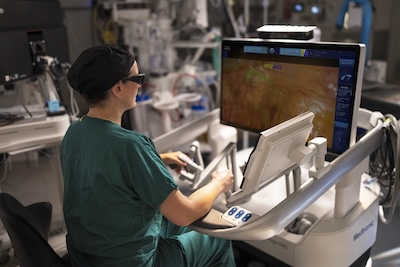
Robotic-assisted surgery is one of the minimally invasive options available at Duke Health. This approach provides improved visualization and precision, which is especially helpful for complex anatomy or oncologic dissections. Dr. Rossi adds that any patient who needs gynecologic oncology surgery or has another complex gynecologic condition can be considered for a robotic-assisted approach. “Women facing a gynecologic diagnosis want two things: to effectively treat their condition and get back to their lives as quickly as possible,” she said. “Robotic-assisted surgery helps make that possible.”
Dr. Rossi is a nationally recognized expert in robotic-assisted surgery for gynecologic cancers. She recently became the lead principal investigator for Embrace Gynecology, a national multicenter clinical trial testing a state-of-the-art robotic system for gynecologic procedures, including cancer surgeries. Read more at duke.is/MIS1.
Embrace Gynecology is enrolling up to 70 patients across five U.S. hospitals in the next few months. Rossi says trials like this are important because they will expand MIS options for women.
Duke is one of only a few national sites participating in this trial, reflecting the expertise of its gynecologic oncology surgical program. Participation in this trial gives eligible patients access to next-generation robotic platforms not widely available in the region.
For gynecologic oncology referrals, the team’s policy is to see patients within 48 hours. “Regardless of diagnosis, patients shouldn’t have to wait longer than that to get access to the subspecialty care offered at Duke that may have a big impact on their outcome trajectory,” Dr. Rossi said. Read the full article at duke.is/MIS2.
In 2025, the National Academies of Science, Engineering and Medicine published A New Vision for Women’s Health Research — Transformative Change at the National Institutes of Health. The consensus report, the goal of which is to direct more attention toward overlooked conditions like endometriosis and fibroids, notes: “Women make up over half of the U.S. population, yet research on women’s health conditions, including those that are female specific such as fibroids ... is severely lacking. Medical advances for women have lagged, in part due to a lack of understanding of basic sex-based differences in physiology.”
Although benign, fibroids can cause significant symptoms — pelvic pain and heavy bleeding — that severely impact quality of life. A 2024 cost analysis showed that the economic burden of uterine fibroids rose from $34.4 billion in 2010 to $41.4 billion in 2022.
Researchers Whitney Robinson, PhD; Friederike Jayes, DVM, PhD; and Evan Myers, MD, MPH, aim to bridge gaps in the understanding of fibroids and make the lives of those affected better. They hope their work ultimately will give women more treatment options.
“The best we can do is tell people that most treatments now seem to work, and they seem to work for several years … other than hysterectomy, there isn’t any guarantee that someone isn’t going to need additional treatment at some point,” said Dr. Myers.
Researchers cite multiple reasons for the neglect of fibroids. Fibroids are non-cancerous and not fatal, and women’s well-being has historically been deprioritized in medical research. “Often the well-being of women is not a huge priority, unfortunately,” Dr. Robinson said. “A lot of people who make the decisions about what gets studied have tended to be men, and, as a result, problems that affect women have been understudied.”
Also, more research is still needed to better understand the disparities among those who get fibroids and the treatments they receive. Fibroids are more common in Black women, who also develop them at an earlier age and experience more severe symptoms.
Toward Better Treatments
The Comparing Procedures for Improving Symptoms of Uterine Fibroids (COMPARE-UF) Study examined how hysterectomy, removal of the uterus and myomectomy, a less invasive procedure to remove fibroids, affect quality of life.
More than 3,100 women enrolled in the study, and most saw substantial improvement in their symptoms regardless of the procedure. However, women choosing hysterectomy had the most dramatic relief.
Fibroids are the leading cause of hysterectomy in the U.S. Dr. Robinson has collected data on the characteristics of people who have hysterectomies and found that they are more common in certain regions of the U.S. For example, they are more common in the South than in the West. “We see these big racial and regional differences in people getting hysterectomies when they’re pretty young, in their 30s and 40s,” Dr. Robinson said.
Dr. Jayes has focused her work on trying to understand the makeup of fibroids, and what makes them grow. She collaborated on a phase one study in which collagenase was injected directly into fibroids. Those treated tended to report reduced pain. For several years, Jayes has collaborated with researchers at North Carolina Central University to enhance collagenase delivery.
Darlene Taylor, PhD, professor of chemistry and biochemistry at NCCU, developed LiquoGel, which serves as a platform to deliver drugs to targeted locations inside the body. When mixed with collagenase, LiquoGel remains liquid at room temperature, but solidifies into a gel upon injection into the warmer body, allowing the enzyme to remain longer, letting it do its job of dissolving the fibroids. Read the full article at duke.is/UFR.